Many older homes in upstate New York were built with plank roof decking, long wooden boards nailed across the rafters instead of the plywood or OSB sheets used today. When it is time for a new roof, homeowners often ask whether those old boards can stay or whether the whole deck needs to be re-sheathed. The honest answer is that it depends on the condition, spacing, and width of the boards. At Center Construction Roofing, we evaluate plank decking board by board during tear-off so you only pay for the repairs your roof truly needs.
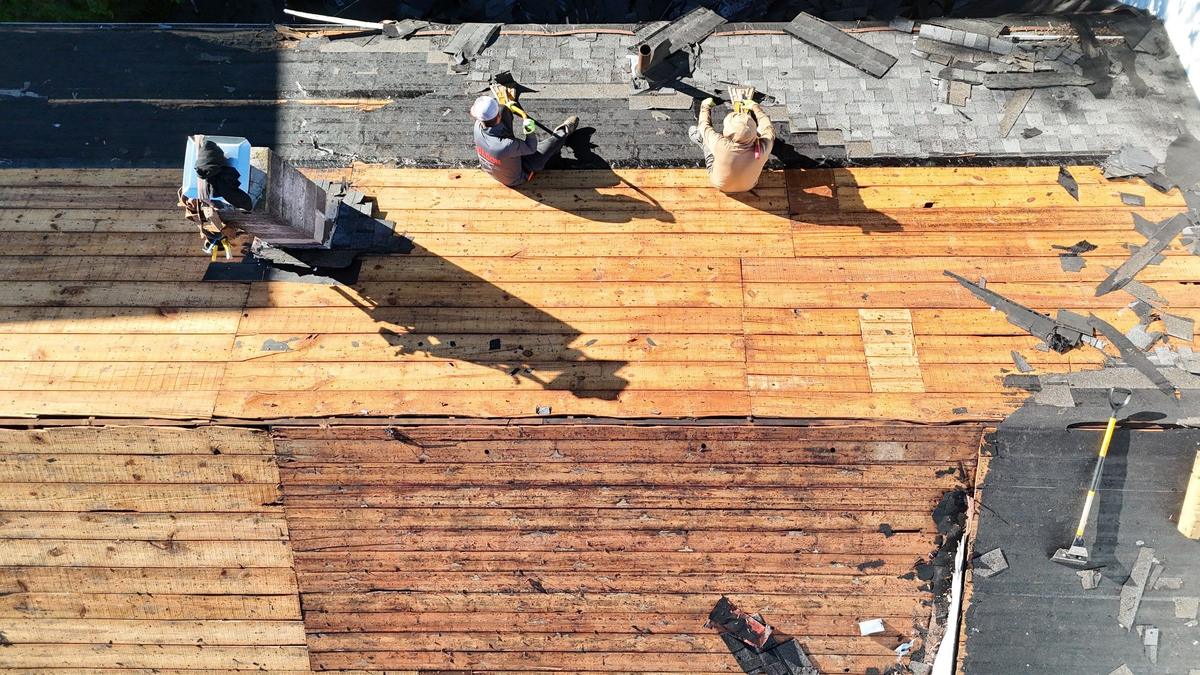
The aerial photo below was taken during one of our roof replacements. You can see clean, solid boards in the upper section, darker water-stained planks in the lower section, and the original shingles still being removed at the ridge.
What Is Plank Roof Decking?
Plank roof decking, also called board sheathing or dimensional lumber decking, is made of individual wood boards, usually 1×6 or 1×8 lumber, laid horizontally across the rafters. It was standard on homes built before plywood became common in the mid-twentieth century, and it is still found on many older houses throughout Albany, Troy, Schenectady, and Saratoga County.
Solid Plank Decking vs. Spaced (Skip) Sheathing
There are two main types. Solid plank decking has boards laid tightly side by side with little or no gap. Spaced or skip sheathing has deliberate gaps between boards and was originally designed for wood shake roofs that needed airflow underneath. Asphalt shingles need a solid, continuous surface, so spaced sheathing is not suitable for shingles without adding new sheathing over it.
Can New Shingles Go Over Plank Roof Decking?
Yes, asphalt shingles can be installed over plank decking when the boards are solid, dry, well fastened, and close together. Shingle manufacturers publish specific deck requirements in their installation instructions, often including limits on board width and gap size. Following those requirements matters, because installing over a deck that does not meet them can affect the shingle warranty.
Plank decking may need repair or new sheathing when:
- Boards are rotted, soft, or delaminating.
- Gaps between boards are too wide for proper nailing and support.
- Boards are cupped, split, or uneven enough to show through new shingles.
- Old nail holes and knots have weakened the wood so new nails will not hold.
- The deck has spaced sheathing designed for wood shakes.
Reading the Damage: What This Roof Showed Us
Tear-off is the only time the deck can be fully inspected. The photo above shows a few common findings.
Water-Stained Boards Near the Eave
The darker planks in the lower part of the roof show long-term moisture exposure. This area is often affected by ice dams, clogged gutters, or failed drip edge. Each stained board is probed for softness. Dark color alone does not always mean the wood is weak, but soft or crumbling boards must be replaced.
Previous Patches and Mixed Materials
You can also see a lighter rectangular patch in the middle of the deck. Older roofs often have earlier repairs from past leaks. We check that previous patches are properly supported on rafters and level with surrounding boards.
Penetrations and the Chimney
Areas around chimneys and plumbing vents are common leak points. Before new shingles go on, we check the decking around every penetration because rot often hides there. For more on this, read our guide to chimney flashing repair for asphalt shingle roofs.
Repair Boards or Re-Sheath the Whole Roof?
When plank decking has problems, there are two main approaches.
Option 1: Replace Damaged Boards Only
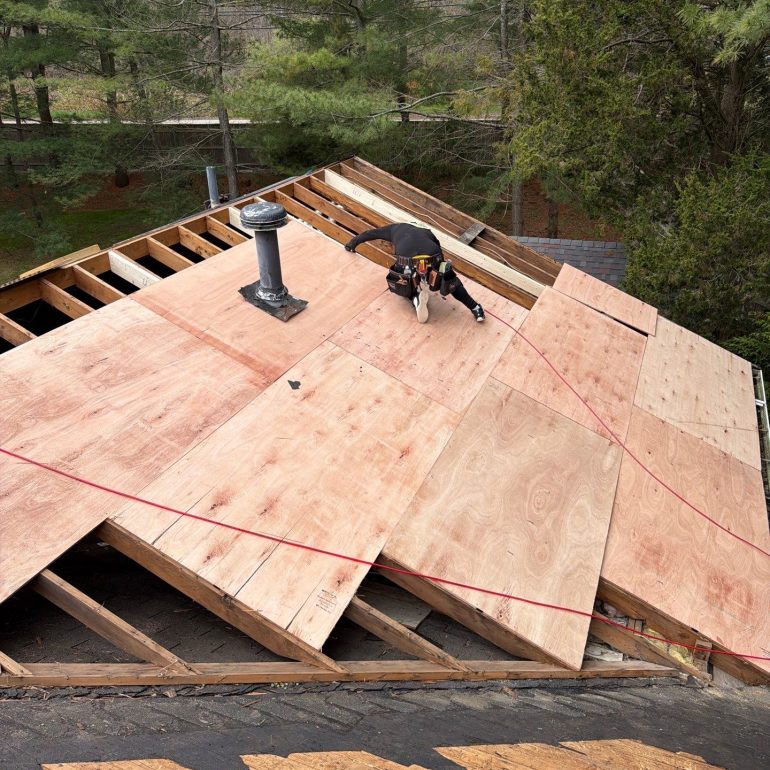
If most of the deck is sound, damaged boards can be cut out and replaced with matching-thickness lumber. This is usually the most affordable option and works well when damage is limited to a few areas, such as the eaves or around a chimney.
Option 2: Install New Plywood or OSB Over the Planks
If the boards are widely spaced, uneven, or have many old nail holes, new sheathing can be installed over the existing planks after damaged sections are repaired. This creates a smooth, uniform nailing surface and strengthens the roof deck. Learn more in our article on why new plywood sheathing matters before a roof installation.
| Factor | Replace Damaged Boards | Re-Sheath Over Planks |
|---|---|---|
| Best for | Mostly solid decks with limited damage | Uneven, gapped, or heavily nailed boards |
| Cost | Lower | Higher |
| Surface flatness | Depends on existing boards | Very smooth and uniform |
| Nail holding | Good in sound wood | Excellent |
Benefits of Keeping Solid Plank Decking
Old-growth lumber used in many older homes is dense and strong. When it is in good condition, plank decking can provide a durable base for a new roof for decades. Keeping sound boards also reduces waste and project cost. The key is an honest inspection, not automatically replacing everything or automatically keeping everything.
How We Handle Plank Decking During a Roof Replacement
On every roof replacement with board sheathing, our crew follows a clear process:
- Remove all old shingles and underlayment down to the bare deck.
- Walk and probe the deck to find soft, rotted, or loose boards.
- Photograph damaged areas and explain repair options before work continues.
- Replace or re-sheath damaged sections and re-nail loose boards.
- Install ice and water barrier at the eaves and valleys, then synthetic underlayment.
- Install new drip edge, flashing, ventilation, and shingles to manufacturer specifications.
Schedule a Roof Deck Inspection
If your home has an older roof, there is a good chance plank decking is under your shingles. Center Construction Roofing is a Owens Corning Preferred contractor serving the Capital Region and southern Vermont. We will tell you exactly what we find and give you clear options. Call (518) 520-4511 to schedule your free roof replacement estimate.
Frequently Asked Questions
How do I know if my house has plank roof decking?
Look at the underside of your roof from the attic. If you see individual long boards running across the rafters instead of large 4×8 sheets, your home has plank decking.
Is plank decking better than plywood?
Neither is automatically better. Solid, dry plank decking made from quality lumber can be very strong. Plywood and OSB provide a more uniform surface and are standard in modern construction. The right choice depends on the condition of the existing boards.
Can shingles be installed over gapped boards?
Not if the gaps are too wide. Asphalt shingles need a solid, continuous deck. Spaced sheathing or boards with large gaps usually need new plywood or OSB installed over them first.
Does replacing roof decking increase roof replacement cost?
Yes. Decking repair is usually priced per board or per sheet in addition to the base roof price. A good contractor explains this pricing in the estimate before work begins.
Will a roofer know the decking condition before tear-off?
Only partly. An attic inspection and walking the roof can reveal soft spots or stains, but the full condition of the deck is only visible after the old shingles are removed.
Does dark or stained decking always need replacing?
No. Staining shows past moisture, but the board may still be solid. Boards that are soft, crumbling, or will not hold nails should be replaced.